Project / 05
Unfortunately....
A paper board game design project exploring strategic gameplay and player interaction mechanics.
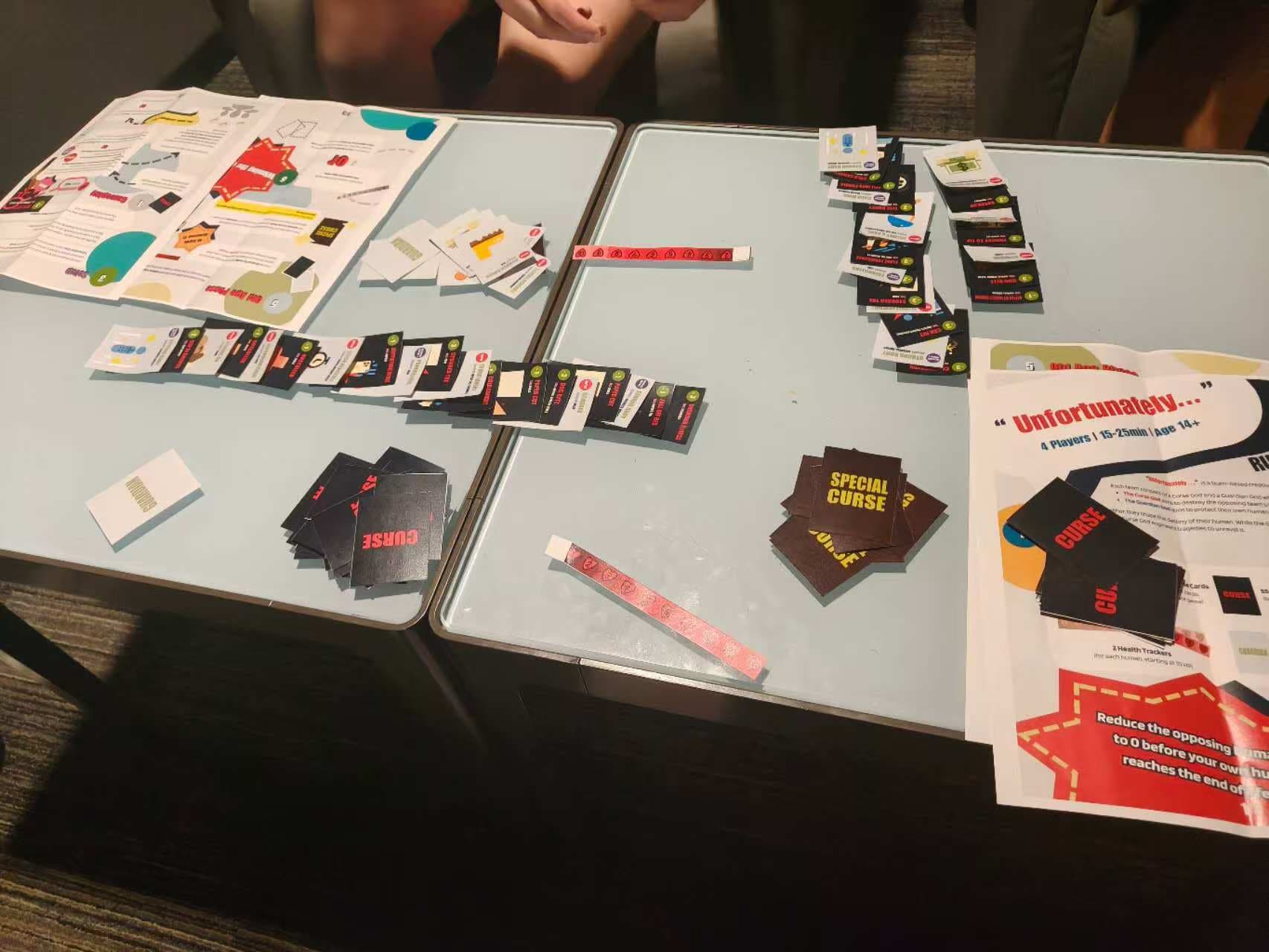
Our team: Olivia Tian, Jerry Shizeng, Qiuyang Wang, Chengyang Lyu
Game Name: Unfortunately…
If you want to play our game, here are the rulebook and cards. You can print them out (Cards should be printed in a double-sided method).
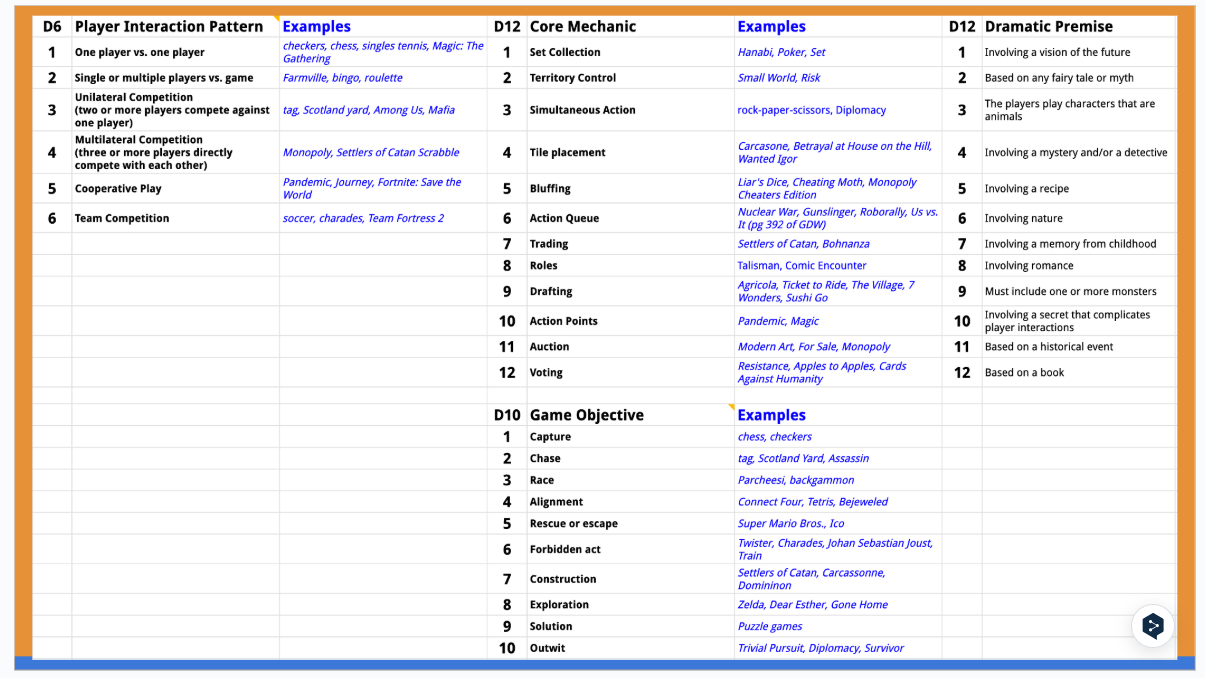
In this project, each one of us rolled a die to randomly choose one category from the grid below as our game constraints. Finally we had:
- Player interaction pattern: team competition
- Core mechanic: Roles
- Game objective: Construction
- Dramatic premise: Involving a vision of the future
First Session: 10/18/2025
In our first meeting, we reviewed our four game requirements: team competition, roles, construction, and involving a vision of the future. Three of them are straightforward. However, we spent a lot of time interpreting “construction.” If we want to design a traditional construction game, the playtime of the game would be hard to control because most of them last for hours. Therefore, we recalled some creative examples related to construction:
- Spider Solitaire: Constructing and maintaining a correct order.
- Evolution: Obtaining resources and developing technologies.
- Card stacking/Building blocks: Instead of building things on a map, players use cards to represent construction. Building blocks is also a popular genre of board games.
By looking into these examples, we had some new ideas. So, “construction” doesn’t have to mean building structures or a physical thing in a virtual world (our game). It can mean creating a concept, representing a development of something, or even forming a story.
Then we thought of a game setting about developing technologies to enter new historical eras, for instance, from the Stone Age to the Middle Ages. Later, we proposed another idea about forming events for a person’s life. Since we need to include roles and team competition, we found that arranging dangerous events for a person and protecting them from those events is worth a try. Therefore, we decided to make a 2V2 card game about life events in the future:
Two players share a single vitality score as teammates. One player casts cursing cards to afflict their opponents, while the other plays curing cards to protect and heal their team. Each card represents a real-life event. When defending, the player using a curing Card must tell an acceptable story that connects the event on the card to how it prevents or mitigates the curse. The success of the defense is subjective and depends on how convincing or meaningful the story is. In this case, our experience goal is: Players will feel amused and delightfully clever as they creatively outwit their opponents using the silliest event logic that makes perfect sense.
Second Session: 10/20/2025
We designed 50+ cards and labelled them with categories. Also, we added a triggering description on the card, indicating that playing them in sequence will cause more damage to the opponent. After 30 cards are played out on the team’s human, that human will enter Old Age. Special cursing cards will then be unlocked to use. They have higher damage and can accelerate the gameplay. Last but not least, two health trackers are provided to track the human’s vitality.
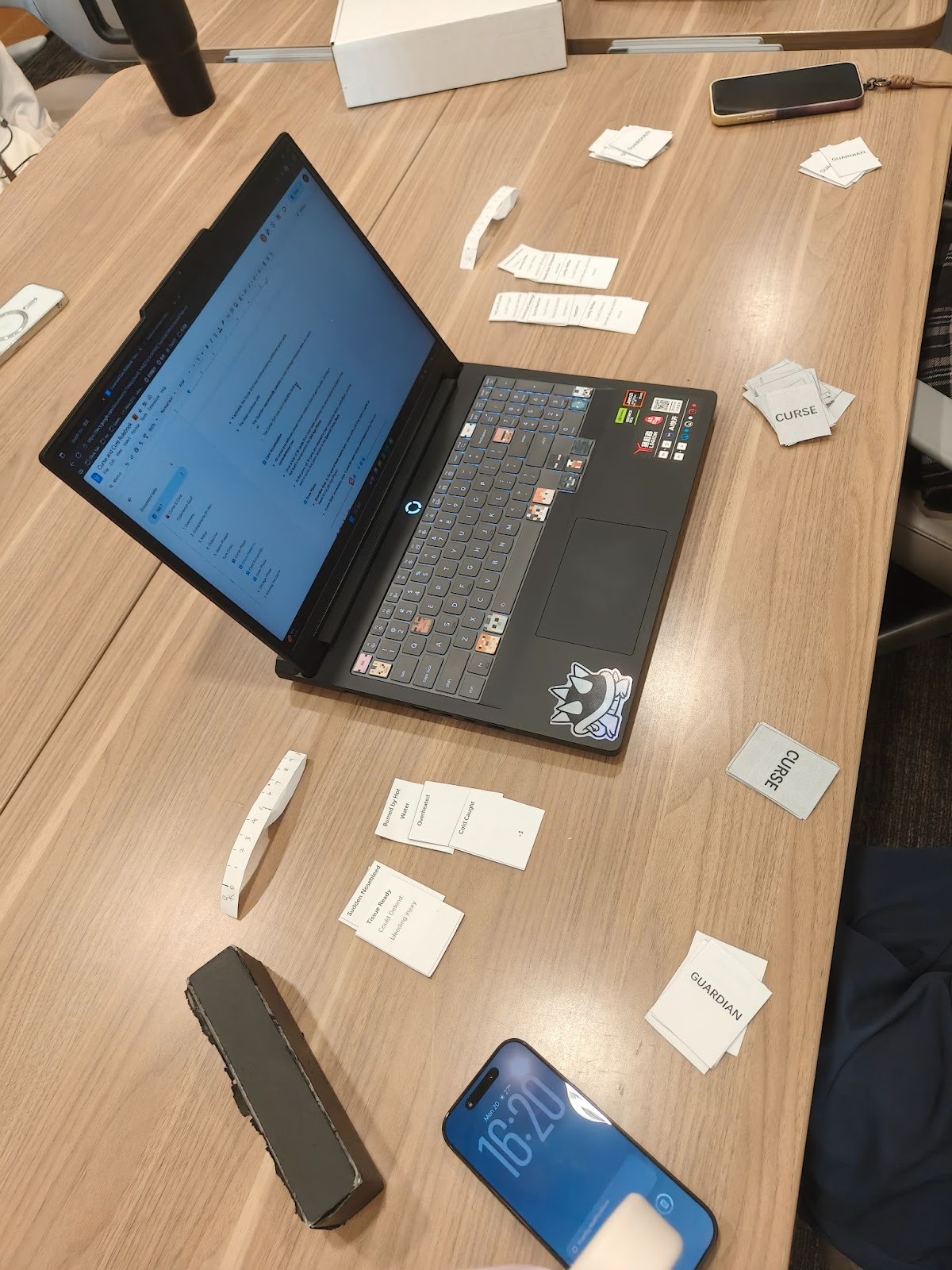
After making our prototype, we conducted four playtests today. Two were with the team, and the other two were external. Within the team, since we could use very silly logic to combine different cursing cards, and somehow we all agreed with it, we seldom used the triggering mechanic that we designed. In the meantime, the playtime was too long. So, we removed the triggering mechanic and lowered the requirement for entering the Old Age to 20 cards. Our second in-team playtest was better. We discussed balancing the Curse God and the Cure God. We wanted to make the Curse God slightly stronger, so we allowed the Curse God to always fulfill the hand to 5, but the Cure God could only fulfill at the end of the turn.
Two external playtests reflected a problem with our card design. Players were surprised by the events on the card, and they really enjoyed telling silly stories. However, they mentioned that there was no strategy in this game. Also, the cursing cards were not balanced at all. Some were very powerful, others were easy to defend. We observed that cards with specific events were usually less powerful, but those with abstract events had high potential, depending on the players’ imagination and sense of humor. This sometimes caused an ongoing argument over eligibility to play a card because players didn’t agree with each other. Last but not least, unlike other card games, we did not include a discard mechanic. This created a difficult situation for the Curing God if the player could not free up their hand to draw useful cards.
Therefore, we decided to add a discard mechanic. Then we labelled our cards with different tags, restricting the use of cards with some effort. As for the “no strategy” feedback, we would like to maintain this silly but fun game experience instead of an intense calculation throughout the game. Additionally, we modified our card design to be more generic for the Curing God.
Third Session: 10/22/2025
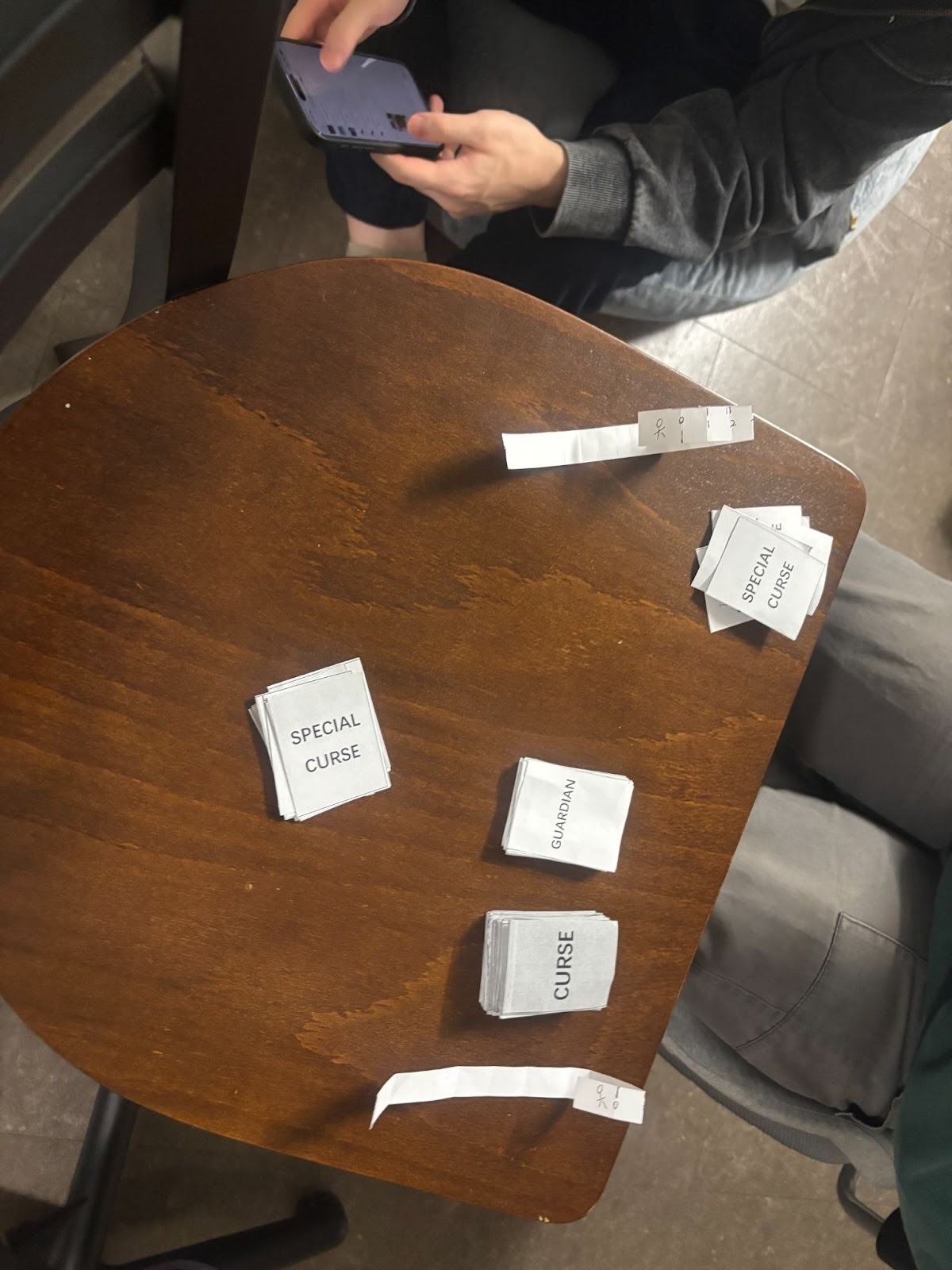
We did a playtest in class today. At first, we noticed that our players were a little quieter compared to other playtesters. But once they could use the Special Curse Cards, things became more interesting and louder. Players need to tell stories to use Curse Cards. This was where our experience goal aimed. During the game, players laughed and felt surprised by how their opponent defended with such a silly story. Even though the time was up, they still wanted to “kill” the opponent.
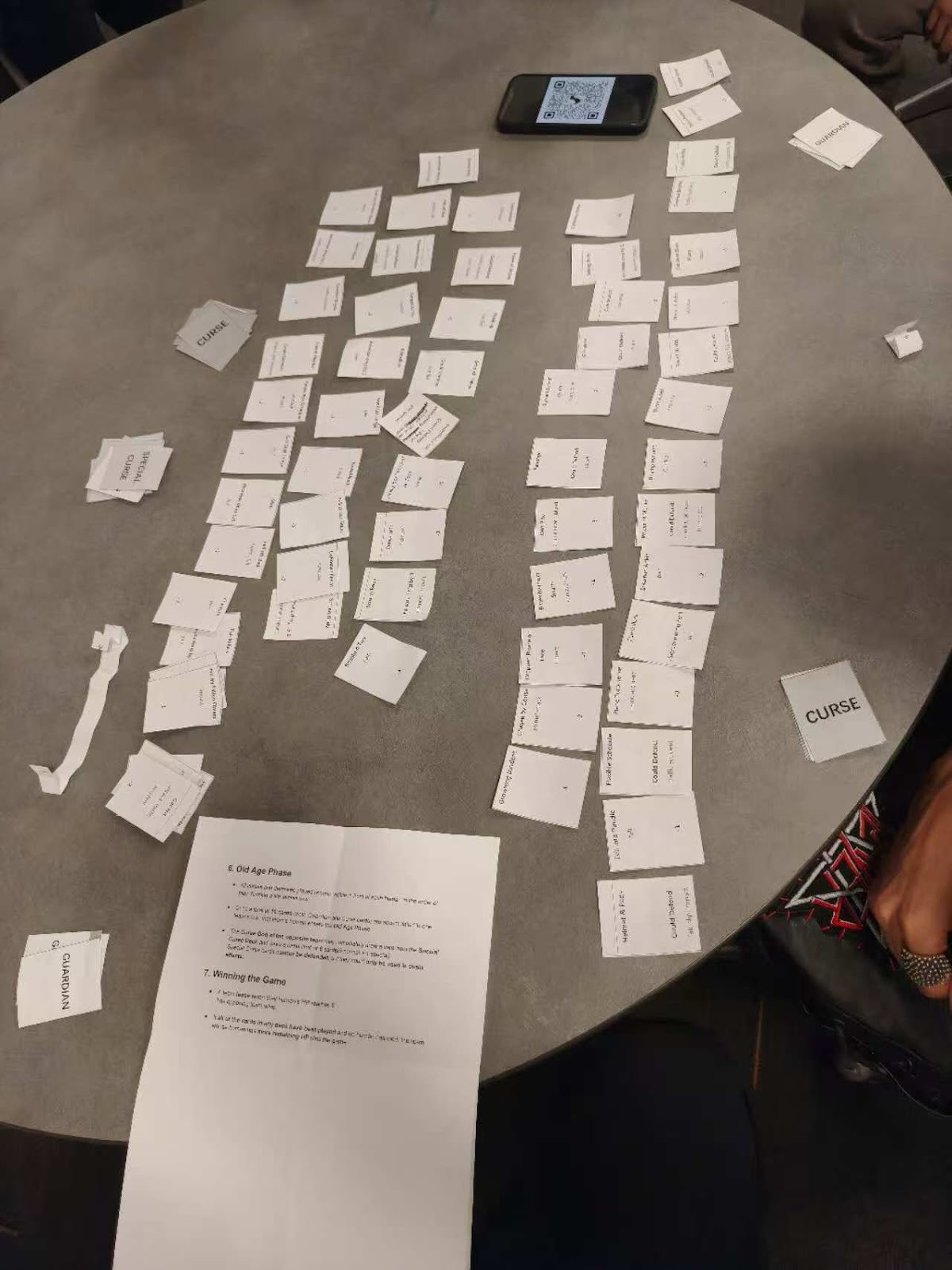
We observed some problems after this playtest:
- Some of the cards were very overpowering.
- While in Old Age, the Guardian God was too powerful, and this could extend the playtime.
- The Guardian God discarding mechanic was also very powerful.
- The rules were not clear.
- Playtime was long.
Fourth Session: 10/24/2025
We made several changes before this playtesting:
- Decrease HP down to 12 => playtime
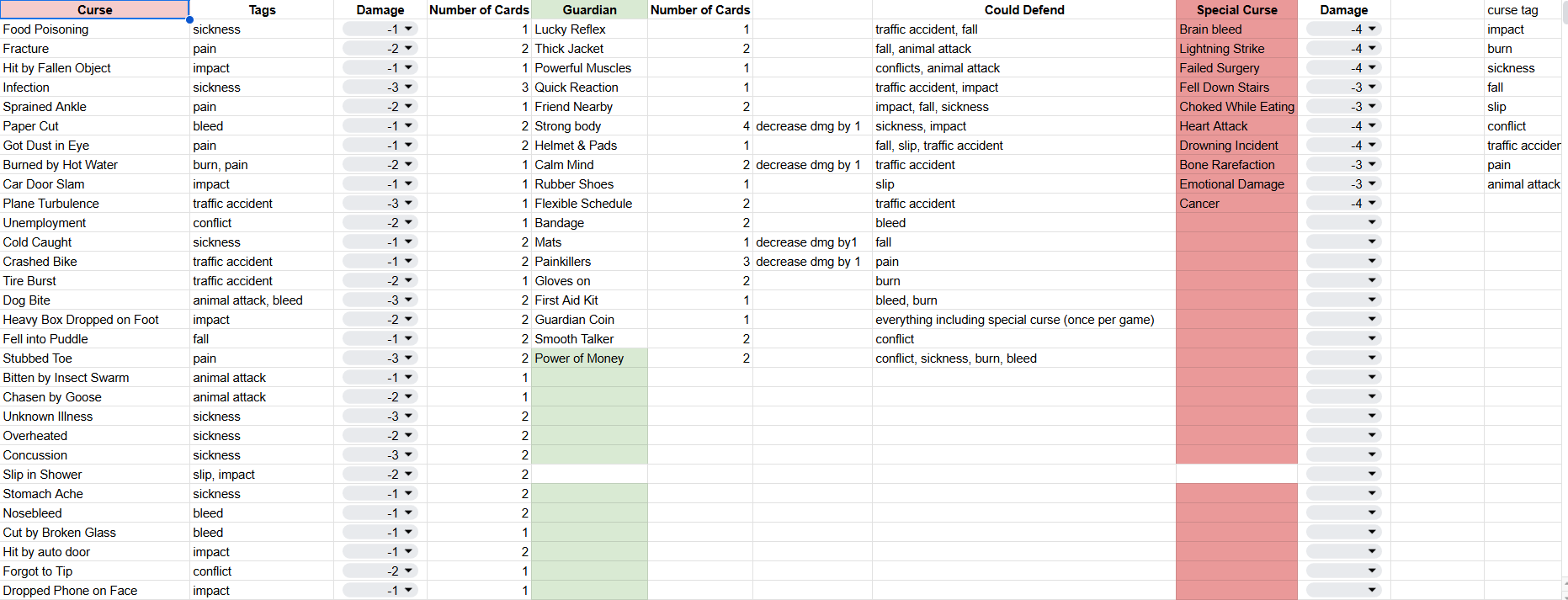
- We balanced our cards by
a. Putting a tag on each Cursing Card
b. Each Curing Card can only defend or reduce damage on a certain tag
c. Adjusting the number of cards and
d. Special Cards cannot be defended - The Guardian God could only discard once per turn
Most of the feedback from the playtest was about the rules.
Fifth Session: 10/27/2025
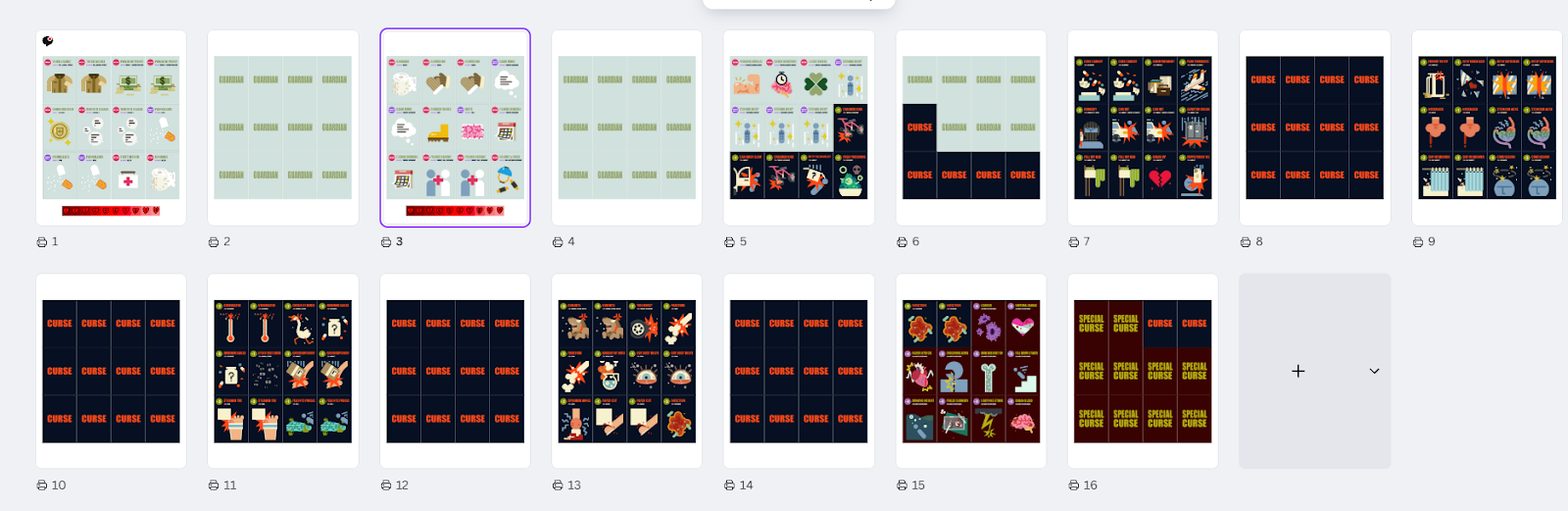
Today, we had our visuals ready. In the meantime, we confirmed that each human will have 10 HP in order to reduce the playtime.
After playtesting, we got some feedback for the visuals and our rulebook:
- They could not distinguish Guardian Cards with different tags due to color similarity.
- We still need to improve the clarity of the rulebook. They mentioned that some details were missing.
- Playtime lasted approximately 22 minutes.
Sixth Session: 10/28/2025
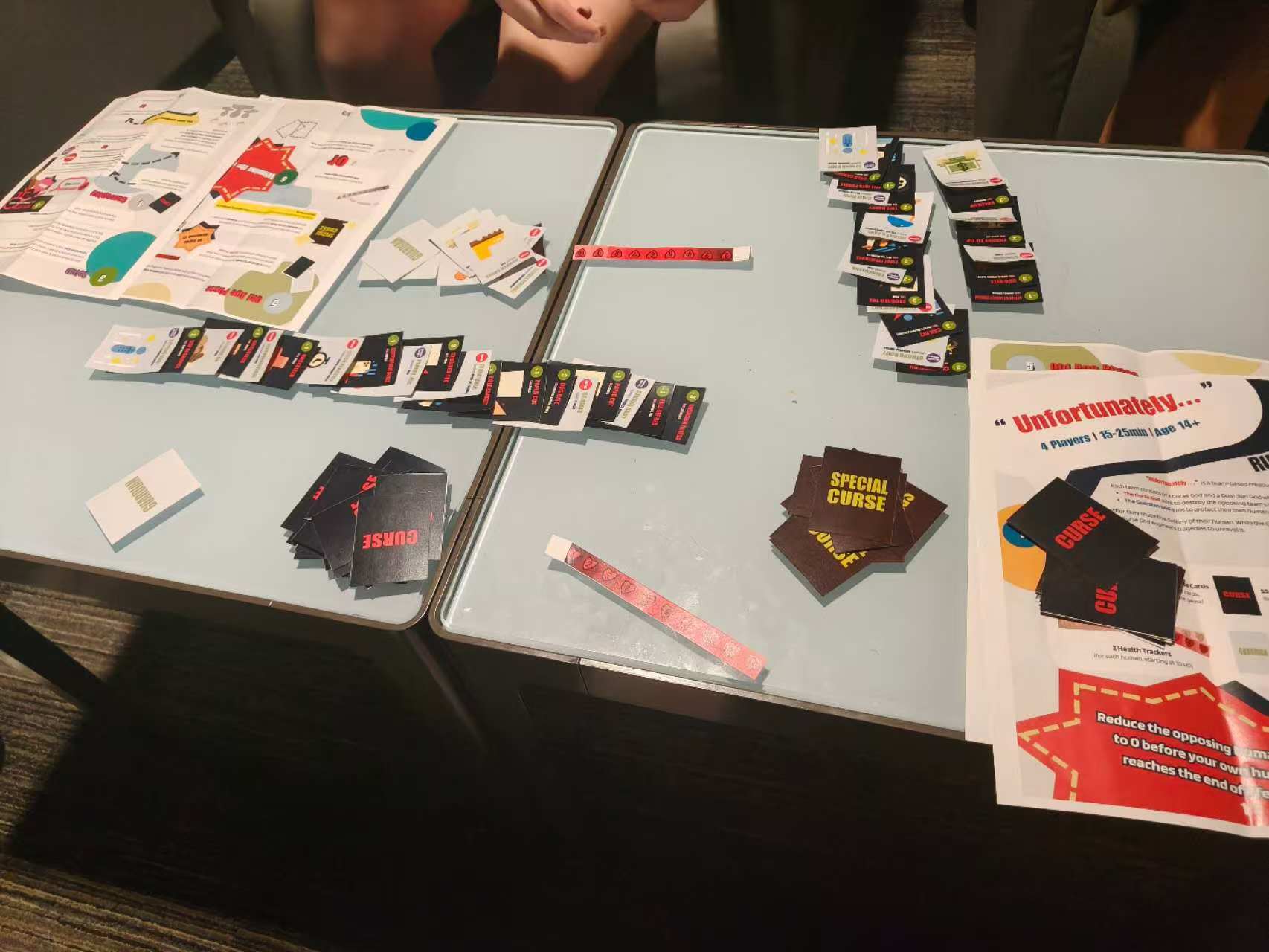
After expanding our rulebook and updating the visuals, we ran our final playtest today. Overall, players enjoyed the game, but they also highlighted something we hadn’t considered: it’s boring for players during their teammate’s turn. They suggested that the Curse God and Guardian God roles should allow for more collaboration, and that special curses could include additional effects, such as forcing discards. We thought they were very good ideas. If we have more time, we will address them in the future.